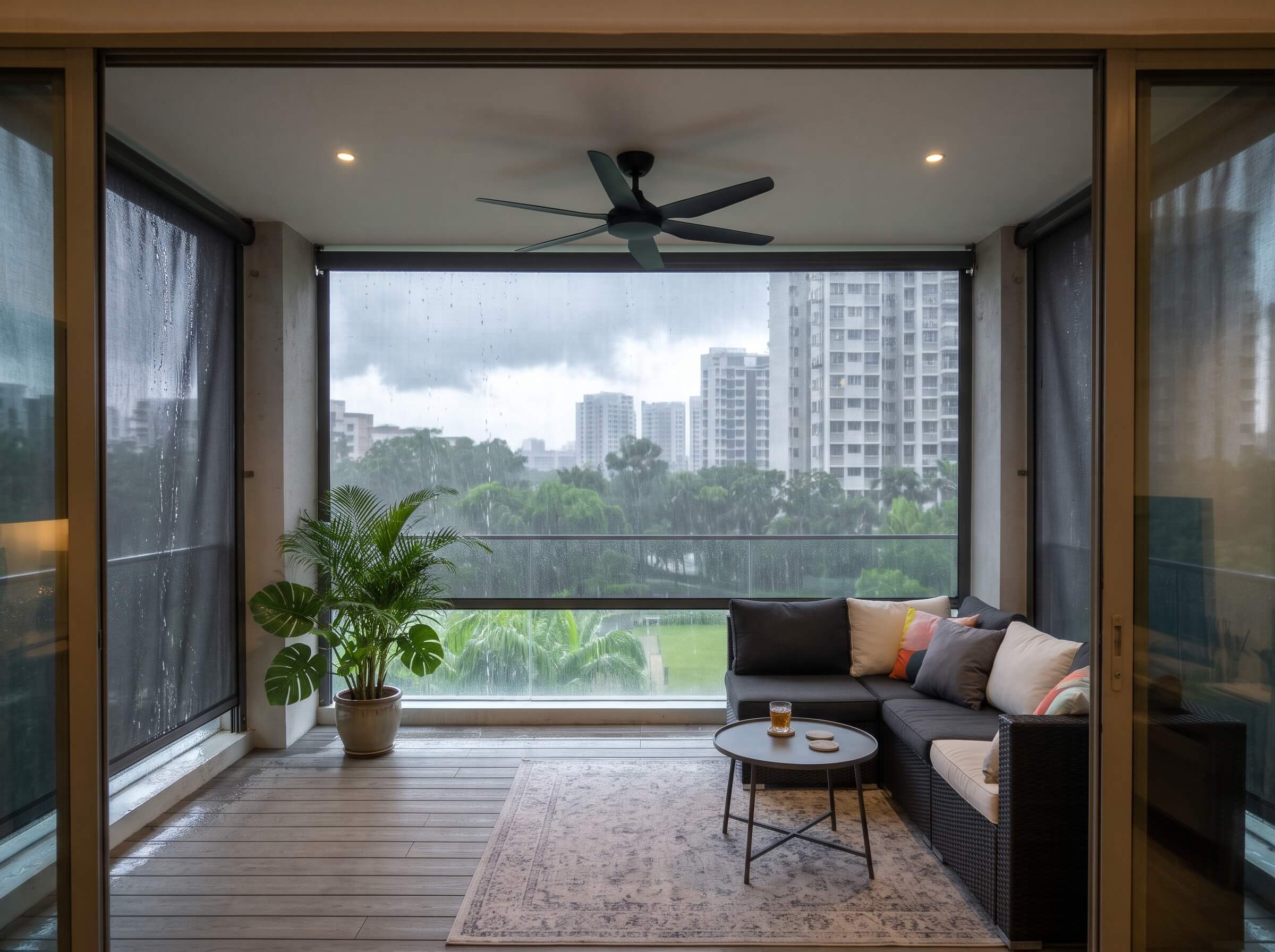
From around November, Singapore's Northeast Monsoon brings weeks of heavy, wind-driven rain — and for most homeowners, that quietly writes off the balcony until the dry season returns. Furniture gets soaked, the floor floods, laundry comes back in wetter than it went out, and the one outdoor space you paid for sits unused through some of the year's longest stretches of rain.
It doesn't have to. The right outdoor blind turns an exposed balcony into a sheltered, usable room in almost any weather — rain or shine. Here's what actually works in monsoon conditions, and what to look for before you buy.
Why Rain Makes a Balcony Unusable
It's not just the rain — it's the wind behind it
Singapore's monsoon rain rarely falls straight down. Gusts drive it sideways onto balconies, so even a deep overhang doesn't keep the space dry. Water reaches furniture several metres back, pools on the floor, and the constant damp warps timber, rusts metal, and leaves mould on walls and cushions. The fix has to stop rain at the opening — not just overhead.
Blocks the Rain
A track-guided blind intercepts rain at the balcony edge, keeping the floor, furniture and walls dry so the space stays usable through a downpour.
Holds Against Wind
Side channels lock the fabric at both edges, so strong monsoon gusts can't blow the blind around or push rain in at the sides.
Protects Furniture
No more hauling cushions and plants indoors before every storm. What's on the balcony stays dry and lasts far longer.
Extends Your Living Space
A sheltered balcony becomes a usable room year-round — for morning coffee, laundry, or working from home — not just in the dry months.
What Actually Works — Compared
Not every "outdoor blind" handles monsoon rain equally. Here's how the common options stack up for wind-driven rain specifically.
| Option | Rain & Wind Performance |
|---|---|
| Overhang / awning only | ✗ Stops overhead rain but not wind-driven rain at the sides |
| Open-side outdoor roller | Partial — blocks some rain, but gaps at the edges let gusts push water in |
| Track-guided (zip) — mesh | ✓ Side channels seal the edges; blocks most rain while keeping airflow |
| Track-guided (zip) — clear/blockout PVC | ✓ Maximum shelter; near-enclosed feel, best for full rain protection |
No outdoor blind is 100% waterproof, but track-guided systems block the large majority of rain — manufacturers commonly cite around 90–95% — because the side channels stop wind-driven rain blowing in at the edges. In practice that's the difference between a soaked, unusable balcony and a sheltered one you can sit in through a storm.
What to Look For in a Rain Blind
If monsoon protection is the goal, these are the features that actually matter — ask about each one when you get a quote.
- Side channels (the "zip track"): The single most important feature. Tracks down both sides hold the fabric tight so wind can't lift it or push rain around the edges. Open-sided blinds without this will always let splash in during a gusty storm.
- Fabric — mesh vs PVC: Dense outdoor mesh blocks rain and glare while still letting air through, so the space doesn't feel stuffy. Clear or blockout PVC gives maximum shelter and an almost enclosed feel, at the cost of airflow. Many homeowners mesh most of the balcony and use PVC where full protection matters most.
- Wind rating: Higher floors catch far stronger wind. A quality system is engineered and rated for wind load — important for condos and high-rise HDB units. Ask what the system is rated to.
- Drainage & run-off: Water should sheet down the fabric and drain away cleanly, not pool at the base. Good installation accounts for where run-off goes so it doesn't flood back onto the balcony.
- Build quality & warranty: Outdoor hardware takes a beating from sun, salt air and rain. Marine-grade or weather-rated components and a solid warranty matter far more here than on indoor blinds. Cheaper "OEM zip" systems can use inferior tracks and motors that fail sooner.
- Motorisation: A motor lets you drop the blind in seconds when a storm rolls in — or schedule it for Singapore's predictable afternoon downpours. On tall or hard-to-reach openings it's close to essential.
"The test of an outdoor blind isn't a sunny day — it's a gusty monsoon afternoon. Side channels and a proper wind rating are what separate a blind that shelters your balcony from one that just gets wet."
— Casa Creativa TeamNot Just Rain — Year-Round Value
The same blind that keeps the monsoon out earns its keep the rest of the year too. With it raised, you keep the open balcony; with it down, you control rain, sun and privacy on demand.
- Sun & heat: Outdoor blinds cut UV, glare and solar heat — a real benefit on a west-facing balcony that bakes in the afternoon.
- Privacy: A mesh blind lets you see out while blocking the view in, useful for close-facing condo blocks.
- Dust & insects: A sealed track keeps out wind-blown dust and bugs, so the balcony — and the room behind it — stays cleaner.
- Smart control: For the full motorised and smart-home picture, see our complete guide to outdoor balcony blinds.
Blinds don't need URA planning permission, but HDB has balcony guidelines and most condos require MCST consent — including an approved colour — for anything affecting the façade. Clear this first: see our HDB renovation rules and condo balcony & window rules guides.
Your Rainy-Season Action Plan
- Choose a track-guided (zip) system — side channels are what stop wind-driven rain
- Pick your fabric — dense mesh for airflow with shade, clear/blockout PVC for maximum shelter
- Confirm the wind rating for your floor and exposure
- Check drainage so run-off flows away, not back onto the balcony
- Clear HDB / MCST approval and confirm the approved colour before ordering
- Consider a motor for one-tap lowering when a storm hits, or scheduled closing
- Book a free site measurement for an exact, compliant quote
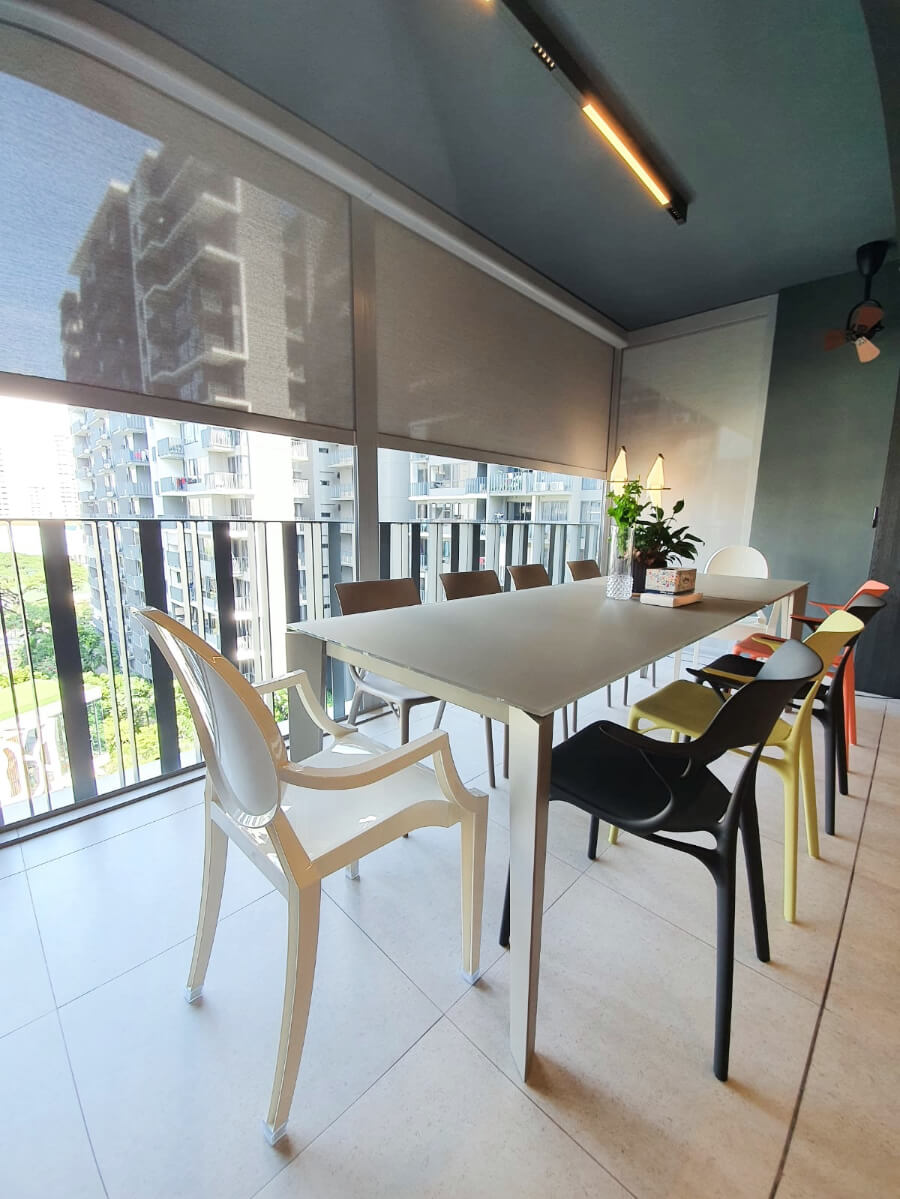
Side-channel zip system that blocks rain, wind and glare. Mesh or PVC, manual or motorised, weather-rated hardware. Free on-site measurement and transparent nett quote.
Frequently Asked Questions
- Do outdoor blinds keep rain out completely? No blind is fully waterproof, but track-guided systems block the large majority of rain (commonly cited around 90–95%) by sealing the edges — enough to keep furniture dry and the space usable in all but the most extreme storms.
- What's the best outdoor blind for the monsoon? A track-guided (zip) system — the side channels resist strong wind and stop edge splash. Dense mesh for airflow, or clear/blockout PVC for maximum shelter.
- Can I use my balcony in heavy rain? In most rain, yes. In an extreme storm with very strong wind, it's sensible to raise the blind to reduce load — easy with a motor.
- Do they need HDB or MCST approval? Blinds don't need URA permission, but HDB guidelines and condo MCST consent (and approved colours) apply. Confirm before ordering.
- Do they help with heat and glare too? Yes — the same blinds cut UV, glare and solar heat, so they earn their keep year-round, not just in the monsoon.