
The consequences of getting an HDB renovation wrong are not minor. Unauthorised works can attract fines of up to S$5,000 per offence, a stop-work order, and — in the worst cases — a reinstatement notice requiring you to restore everything to its original condition at your own expense. For balcony installations in particular, where the rules around blinds, grilles and enclosures are frequently misunderstood, it pays to understand exactly what applies before you commit to anything.
This guide focuses on what most HDB homeowners actually want to do: install outdoor roller blinds (including zip-track systems), replace or upgrade window grilles, or add invisible grille. We cover what's permitted without a permit, what requires HDB approval, what the contractor rules say, and what is permanently off the table. Where relevant, we include the specific conditions you need to satisfy.
The information in this blog article is provided as-is, and Casa Creativa makes no representations regarding its accuracy or completeness. Rules do change, and individual flat types, block designations, and estate-specific conditions can affect what applies to your unit. Always verify your specific situation directly with HDB via MyNiceHome (hdb.gov.sg) before committing to any installation.
The One Rule That Overrides Everything Else
Before looking at any product-specific rules, there is one overarching principle from the Urban Redevelopment Authority (URA) that applies to every Singapore home regardless of property type: you cannot permanently enclose your balcony.
Under URA guidelines, balconies in Singapore are classified as semi-outdoor spaces. The critical legal distinction is between retractable screening and permanent enclosure. Fixed glass panels, solid walls, and anything that seals the balcony from the elements entirely converts it from a semi-outdoor space into an enclosed room — which changes its use classification, adds floor area to your unit that wasn't approved, and is not permitted.
What "permanent enclosure" means in practice
- Not allowed: Fixed floor-to-ceiling glass panels across the balcony opening
- Not allowed: Solid walls, brickwork, or permanent cladding enclosing the balcony
- Not allowed: Any installation that converts the balcony into a room, regardless of material
- Allowed: Retractable roller blinds and zip-track systems that can be opened fully
- Allowed: Invisible grille or traditional window grille (safety barriers, not enclosures)
- Allowed: Retractable awnings that fold back when not in use
This distinction matters because many homeowners see zip-track or Ziptrak® blinds and worry they constitute an "enclosure." They don't — precisely because they are retractable. When fully opened, the blind is rolled away and the balcony remains entirely open to the outdoors. It's the same reason a sliding glass door isn't an enclosure: it can be moved. The URA rule targets permanent structural additions, not retractable screening systems.
Balcony Blinds - What HDB Allows
The short answer is yes — HDB permits retractable outdoor waterproof blinds, including track systems on balconies and service yards. For standard retractable blind installations, you generally do not need to submit a separate HDB renovation permit, provided your installation satisfies the conditions below.
Retractable roller blinds
Including track systems. No HDB permit typically required for standard installations within the balcony recess.
Motorised blind systems
Motor and automation upgrades are treated as part of the blind system — no separate permit required if the blind itself is compliant.
Fully solid PVC fabrics
0% openness (full blackout PVC) may raise questions about natural ventilation requirements. Confirm with your installer and HDB for your specific flat type.
Fixed or permanent enclosure
Any blind system bolted in a way that cannot be retracted or removed, permanently sealing the balcony. Violates URA guidelines on balcony enclosure.
The Conditions You Must Satisfy
HDB's exemption from permit requirement for retractable blinds is conditional. All of the following must apply:
- Retractable, not fixed: The blind must be fully retractable — when open, it must not obstruct the balcony opening or act as a permanent barrier.
- Within the balcony recess: The system must be installed within the existing balcony structure — ceiling-mounted brackets inside the balcony are the standard compliant method. You cannot extend the blind beyond the balcony parapet.
- No hacking into structural elements: Drilling into load-bearing walls, reinforced concrete beams, columns, or floor slabs is strictly prohibited without separate structural approval. Balcony ceilings and internal walls within the balcony recess are generally acceptable — but confirm your installer knows the difference.
- Colour in keeping with the building: While blinds are more flexible than fixed grilles on colour, avoid anything that clashes dramatically with the estate's designated colour scheme. Neutral tones — white, beige, grey, charcoal — are safe choices in almost all HDB estates.
- Ventilation must be maintained: HDB requires that balconies and service yards remain able to ventilate. Fully solid enclosures that block all airflow are not permitted. A mesh blind with 3–10% openness satisfies this; even most PVC blinds do when they can be opened.
- Natural ventilation for blinds on service yards: Service yard blinds follow similar rules — retractable and ventilated. They are commonly used for laundry areas and are generally permitted on the same basis as balcony blinds.
If you choose a very low-openness fabric (0–1%) on a west or south-facing balcony with significant afternoon sun, be aware that heat can build up between a closed blind and your sliding glass door. This trapped heat causes thermal stress on your glass panels — a real concern with older or thinner glass. A 3–5% openness mesh fabric provides strong UV and rain protection while allowing minimal heat exchange that prevents this. It's worth discussing with your installer before committing to full blackout PVC.
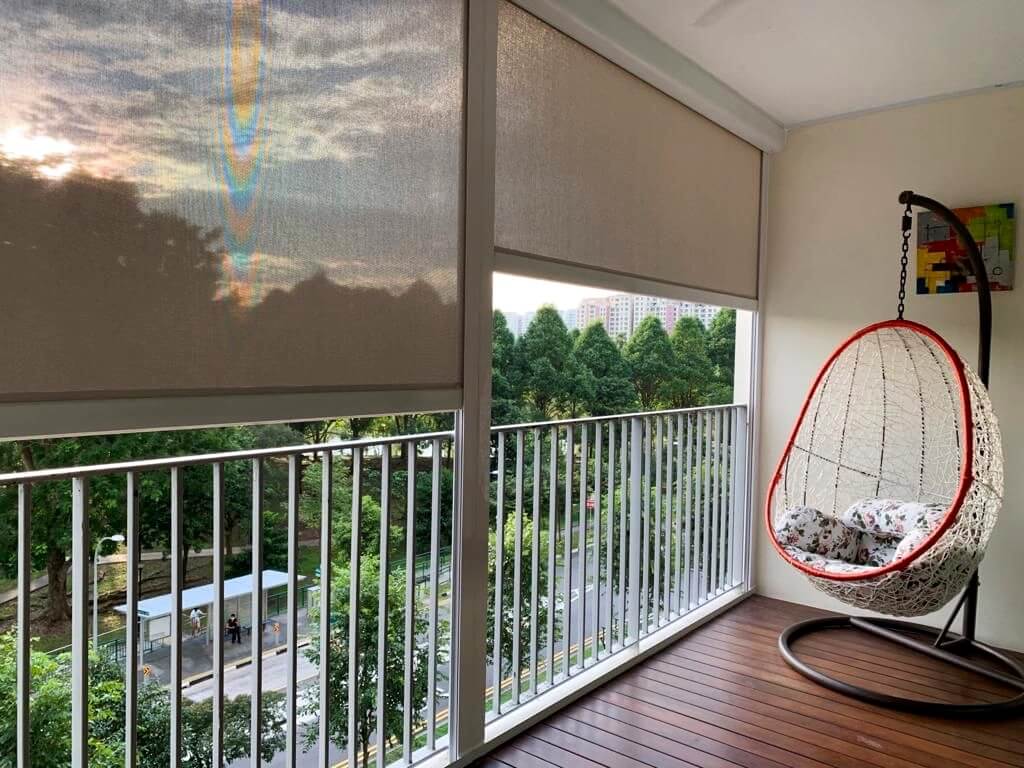
Protect your balcony against sunlight, rain and lack of privacy - all while elevating your living space.
Invisible Grille - Rules, Permits & Approved Designs
Invisible grille is permitted in HDB flats — but unlike retractable blinds, installing or replacing any grille on your balcony parapet or service yard requires a renovation permit from HDB. This applies to invisible grille, traditional metal grille, and any other grille type. It is not optional.
The permit requirement exists because grilles are classified as safety barriers — structural features that affect the building's external facade and carry an obligation to meet specific safety standards. HDB needs to verify that what you're installing is appropriate for your flat type, matches the approved design scheme for your block, and is installed by a qualified contractor.
What "HDB-approved design" means
For flats handed over from 1 July 2007 onwards, any grille installed at the balcony or service yard must use one of the designs approved by HDB for your specific building. You can review the approved designs for your flat through My HDBPage (hdb.gov.sg). If invisible grille is listed as an approved option for your block, you can proceed — your contractor will install it to the approved specification.
For older flats (handed over before 1 July 2007), the primary rule is that metal grilles must be fixed internally and must not protrude from the main facade. This applies to invisible grille as well — the frame and cable system should sit within the balcony, not extending beyond the outer edge of the parapet.
Invisible grille (balcony parapet)
Permitted if invisible grille is in the approved design list for your block. Renovation permit required before installation. Must be installed internally.
Invisible grille (service yard)
Permitted on the same basis as balcony grille. Permit required. Design and colour must comply with HDB scheme for your building.
Openable / sliding invisible grille
Openable variants are available but must be confirmed against your block's approved designs. Check via My HDBPage before ordering.
Grille height exceeding unit height
No grille — invisible or otherwise — may exceed the height of your unit. The installation must stay within your floor-to-ceiling height.
The Contractor Rule for Grilles
Any grille installation at the balcony or service yard must be carried out by a contractor listed in HDB's Directory of Renovation Contractors (DRC). Since grille installations at balcony parapets are classified alongside window works, your contractor may also need to be a BCA-Approved Window Contractor (AWC) registered with HDB — particularly where the grille interfaces with an existing window structure.
Engaging an unlisted contractor for permit-required works is itself a regulatory violation, regardless of how experienced that contractor may be. Always verify registration before you sign.
Log in to My HDBPage → My Flat → Purchased Flat → Renovation → Renovation Guidelines. Your flat's factsheet will show which grille designs are approved for your specific unit and block. Some older blocks have a more limited list; newer estates often include invisible grille as a standard approved option. If it's not on the list for your block, contact HDB directly — they can clarify and, in some cases, grant individual approval.
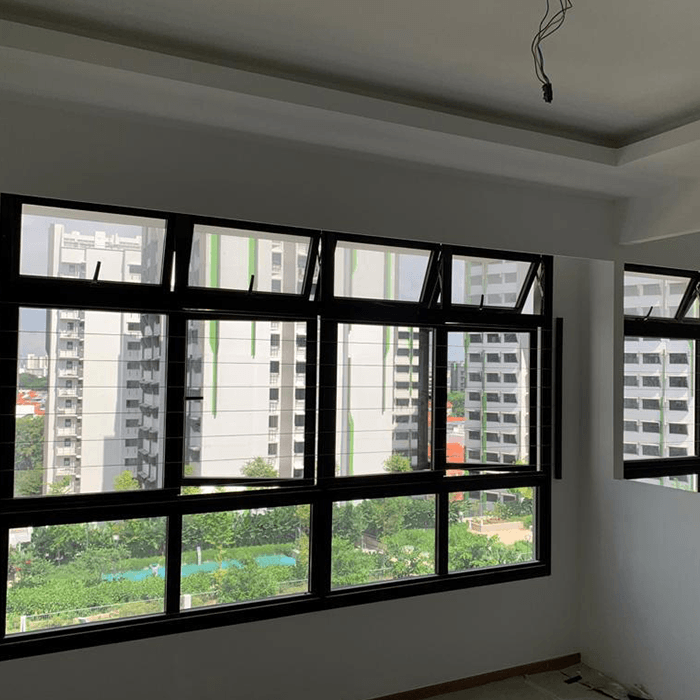
HDB-compliant, SS316 stainless steel cables. We handle the renovation permit application on your behalf.
What You Cannot Do — No Exceptions
Some balcony works are not just permit-required — they are permanently prohibited under HDB's renovation framework, regardless of how the request is framed or who is doing the installation. These are hard limits that apply to all HDB flats:
| ✓ Permitted (with or without permit) | ✗ Not Permitted — Ever |
|---|---|
| ✓ Retractable outdoor roller blinds and zip-track systems | ✗ Permanently enclosing the balcony with glass, walls or fixed panels |
| ✓ Invisible grille or traditional grille (with permit, approved design) | ✗ Hacking, drilling or cutting into structural walls, RC beams, columns or floor slabs |
| ✓ Replacing the railing on top of the balcony parapet wall (no permit needed) | ✗ Installing awnings or external fixtures that protrude outside the unit boundary |
| ✓ Painting the internal balcony walls and ceiling | ✗ Painting the external facade of the building (corridor walls, external balcony face) |
| ✓ Laying floor finishes over existing balcony tiles (adhesive only, max 13mm) | ✗ Raising floor level without HDB approval (requires permit) |
| ✓ Retractable shade sails or canopies (where structurally feasible) | ✗ Overhead caging (caging up) at the balcony |
| ✓ Placing planters and furniture within the balcony | ✗ Storing or using combustible materials on the balcony |
The most expensive mistake a homeowner can make is installing an unauthorised permanent enclosure and then discovering it when they try to sell. HDB can issue a reinstatement order requiring you to remove everything and restore the balcony to its original state — entirely at your cost. This regularly happens during resale inspections. A compliant retractable blind installation never carries this risk.
HDB-Registered Contractors - Why It's Non-Negotiable
For works that require a renovation permit, you are legally required to engage a contractor from HDB's Directory of Renovation Contractors (DRC). This is not a recommendation — it is a statutory requirement under the Housing and Development (Renovation Control) Rules, most recently updated by Regulation S 725/2025 in December 2025. Hiring an unregistered contractor for permit-required works is itself a prosecutable offence.
How to Verify a Contractor
Do not rely on a contractor's word alone. Verify registration directly on the HDB InfoWEB portal before signing anything. Search by company name or UEN number. For grille and window-adjacent works, additionally confirm that the contractor holds BCA Approved Window Contractor (AWC) status where required.
What Good Contractors Do For You
- Permit application: A registered contractor handles the HDB permit application on your behalf, including submitting the correct documentation and drawings. You shouldn't need to navigate this yourself.
- Design verification: They check that the grille or blind design is approved for your specific block before ordering materials — not after installation.
- Structural awareness: They know where the structural elements of your unit are and will not drill into restricted zones. This protects both you and your neighbours.
- Permit timeline management: Standard HDB permit processing takes 7–14 working days. A good contractor builds this into the project schedule. Don't commit to a start date with your movers before approval is confirmed.
Working Hours and BTO Restrictions
Two rules that frequently catch homeowners off guard: the 2026 renovation working hour rules, and the BTO three-year restriction.
Renovation Working Hours (2026)
9am – 6pm, Mon–Sat
Standard renovation works including blind installation, grille installation, and minor drilling.
9am – 5pm, Weekdays Only
Heavy drilling, hacking, tile cutting. Not permitted on Saturdays. New quiet hour: 1pm–2pm daily.
Sundays & Public Holidays
No renovation works of any kind. This applies to all HDB units without exception.
Quiet Hour: 1pm – 2pm
A mandatory daily quiet period during which noisy works must pause. Applies every working day.
The BTO Three-Year Rule
If you recently collected your BTO keys, one specific restriction applies during the first three years from your flat's Temporary Occupation Permit (TOP) date: you cannot replace bathroom or kitchen wall and floor tiles. This protects the original waterproofing membrane beneath the wet-area finishes.
This rule does not affect blind or grille installation — those can proceed normally once you have keys and the relevant permits. It's included here because many new BTO homeowners encounter it when planning renovation works broadly.
Colour & Design Rules - Maintaining Facade Harmony
HDB maintains strict control over the external appearance of its buildings — and this extends to everything visible from outside your unit. The principle is facade harmony: every unit in a block should contribute to a coherent, uniform exterior appearance rather than presenting a patchwork of individual choices.
- Grille colour: Must match the scheme approved by HDB for your building. You typically cannot choose a trending colour if your block uses a different designated scheme. Check your flat's factsheet for the approved colour options.
- Blind fabric visibility: While blind fabric choices are more flexible than fixed grilles, anything highly visible from outside — particularly bright or non-neutral colours — may attract attention from your block's estate management. Neutral tones (white, grey, beige, charcoal) are safe in virtually all estates.
- Window frames and grille frames: Must match the building's original specification or the approved replacement scheme. You cannot change from one colour to another arbitrarily.
- External painting: Painting the external face of your balcony (the side facing outside) is not permitted. Only internal surfaces within the balcony recess are yours to paint.
When in doubt about blind or grille colour, choose white, off-white, or light grey. These are approved in virtually every HDB estate and blend cleanly with the majority of Singapore's public housing colour schemes. Darker greys and charcoals are increasingly accepted in newer estates. Avoid anything with a strong hue.
Your Pre-Installation Checklist
Before you confirm any installation — blind, grille, or otherwise — work through this checklist. It takes ten minutes and could save you a significant amount of money and stress later.
-
1Check your flat's approved designs on My HDBPage
Log in to hdb.gov.sg → My HDBPage → My Flat → Renovation Guidelines. Confirm which grille designs and colours are approved for your specific block. Download and keep this document — a good contractor will ask for it.
-
2Verify your installer's contractor registration
Search for your contractor on HDB's Directory of Renovation Contractors (DRC) at HDB InfoWEB. For grille works, also check BCA-AWC status if the grille interfaces with window structures. Do not accept a photocopy of a certificate — verify directly on the government portal.
-
3Confirm who is handling the permit application
For grille installation, a renovation permit is required before work begins. Your contractor should handle this — confirm in writing that permit submission and approval is their responsibility, and that they will not commence work until approval is received (7–14 working days).
-
4Know your structural elements
Ask your contractor to identify the load-bearing walls, RC beams, and columns in your balcony area before any drilling. If they cannot tell you, that is a red flag. No fixing should go into structural elements without separate PE endorsement.
-
5Confirm blind fabric openness vs your window type
If your balcony has older or thinner glass sliding doors, avoid fully solid PVC fabric (0% openness). Discuss with your installer — a 3–5% mesh fabric gives strong rain and UV protection while preventing thermal stress on the glass.
-
6Plan for the permit timeline in your schedule
If you're renovating around a move-in date, build in the 7–14 working day permit processing time before any works can begin. Do not schedule your movers until your renovation permit is confirmed in hand.
- Approved design confirmed on My HDBPage for your specific block
- Contractor verified on HDB's DRC (and AWC where required)
- Permit timeline factored into your renovation schedule
- Structural zones identified — no drilling into beams or load-bearing walls
- Fabric openness suitable for your glass type and sun exposure
- Colour matches or is consistent with building's approved colour scheme
- Written confirmation that blind system is retractable, not permanently fixed
The Bottom Line
For the two most common balcony upgrades — outdoor roller blinds and invisible grille — the regulatory picture in 2026 is clearer than most homeowners expect. Retractable outdoor blinds, including zip-track systems like Ziptrak®, are generally permitted without a specific HDB renovation permit, provided they are installed within the balcony recess, don't touch structural elements, and remain fully retractable. Invisible grille is permitted and increasingly common, but it does require a renovation permit and must use an HDB-approved design for your block.
What is not permitted — and never will be — is permanent enclosure of the balcony. This is the line that matters most, and it's the one most likely to cause problems down the road if crossed. The good news is that a retractable blind combined with invisible grille gives you everything a permanent enclosure would — weather protection, UV shading, privacy, and safety — without crossing that line.
The simplest way to navigate all of this: work with a registered contractor who handles the permit process as a standard part of their service, knows the approved designs for your block, and can confirm compliance in writing before a single drill turns. The few extra questions it takes to establish that are worth asking.