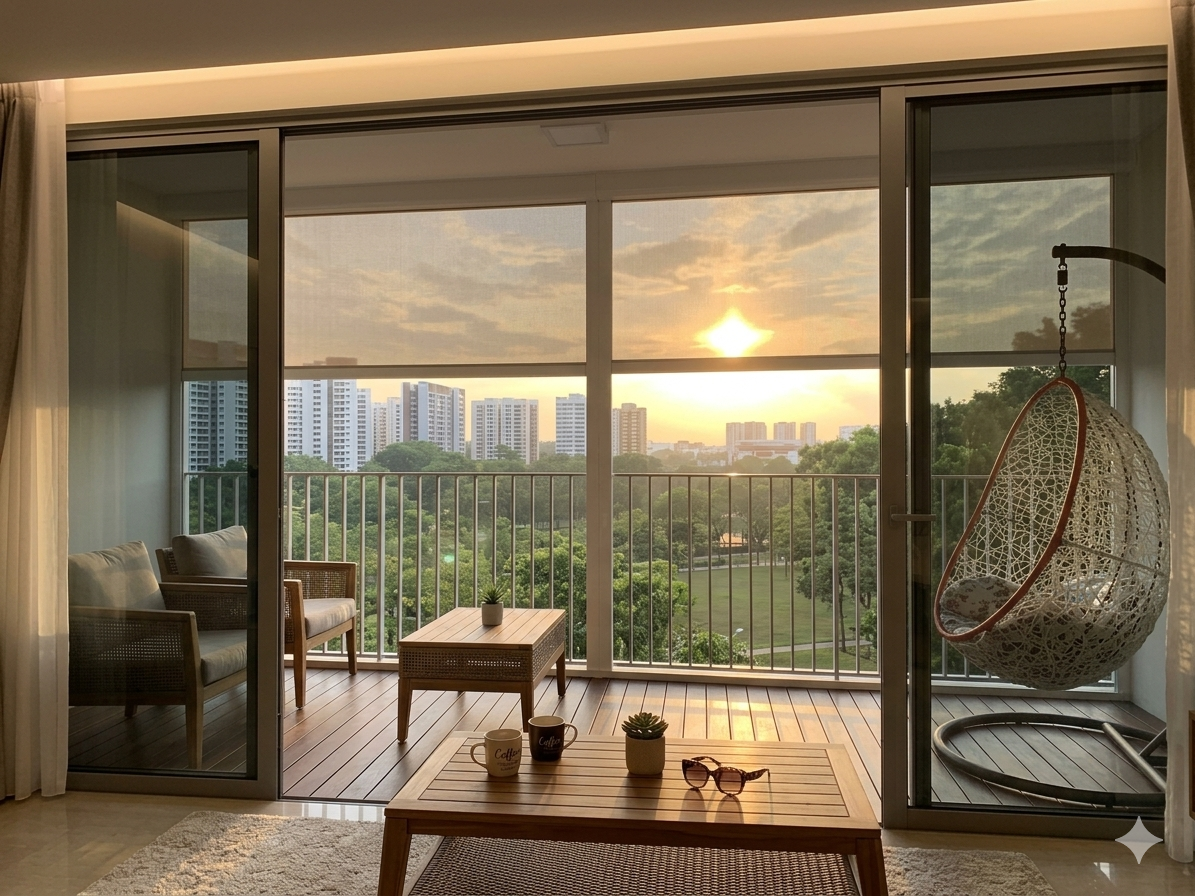
The average Singapore HDB balcony is about 5–8 square metres. Most sit underused — a drying rack at one end, a box or two of things nobody knows where else to put. And yet that same space, properly considered, could be the most enjoyable part of your home: a morning coffee spot, a living herb garden, a breezy evening lounge, or a quiet reading nook with a view.
The good news is that transforming a balcony doesn't require a major renovation. It requires a plan. The twelve ideas below are drawn from real Singapore homes — HDB flats, condominiums, and landed terraces — and they apply whether your space is 4 sqm or 40 sqm. Start with the ones that fit your situation, and build from there.
1. Commit to a Colour Palette Before You Buy Anything
Start with colour — everything else follows
The most common reason a balcony ends up looking cluttered despite having nice individual pieces? No colour discipline. A terracotta pot here, a grey chair there, a bright cushion that was on sale — the result is a space that never settles into a mood.
Pick two or three anchoring colours and commit to them before buying a single item. Everything else — furniture, pots, cushions, the blind fabric, even the rug — should sit within that palette. The space will look curated, not collected.
Singapore's outdoor spaces tend to look best in one of a few directions. Natural, earthy tones — sandy beige, warm terracotta, forest green — work beautifully against concrete and wood. Cool, airy tones — white, sage, pale grey — feel clean and expand the sense of space. Dark, moody palettes — charcoal, deep olive, black — can make even a small balcony feel like a boutique hotel corner, especially in the evening.
When choosing your outdoor blind fabric, treat it as the largest piece of colour in the space — because it is. A warm beige or soft grey blind naturally anchors any palette. A brighter or clashing colour, once installed, is very hard to ignore. Samples are always worth requesting before you commit.
2. Define the Space with an Outdoor-Rated Rug
A rug turns a balcony floor into a room
An outdoor rug does something simple but transformative: it tells the brain this is a room, not a corridor. The furniture sits within a defined zone. The space feels intentional. And the cold, hard tile or concrete underfoot suddenly has some warmth and texture.
For Singapore's climate, you need something purpose-made for outdoors — polypropylene and recycled PET rugs are the gold standard here. They dry in under an hour after rain, resist mould and mildew, and hold their colour under UV exposure for years.
- Material to choose: Polypropylene or recycled PET. Avoid natural fibres like jute or sisal outdoors — they mould and disintegrate quickly in Singapore's humidity.
- Size matters: For a small HDB balcony, even a 120×180cm rug makes a dramatic difference. Go as large as the space allows — the most common mistake is a rug that's too small.
- Colour strategy: Patterned rugs are forgiving in outdoor spaces — they hide dirt and wear gracefully. Geometric patterns in earthy tones are particularly versatile.
- Maintenance: Rinse with a hose and leave to dry. Flip occasionally to encourage even UV exposure and wear.
3. Control the Sun and Rain with Outdoor Blinds
Make your balcony usable in any weather
Here's the truth about Singapore balconies: without weather management, even the most beautifully decorated space becomes unusable from around 11am to 4pm on a clear day, and completely unusable the moment it rains. All the money spent on furniture, plants, and accessories doesn't add up to much if you can only enjoy the space for a couple of hours each morning.
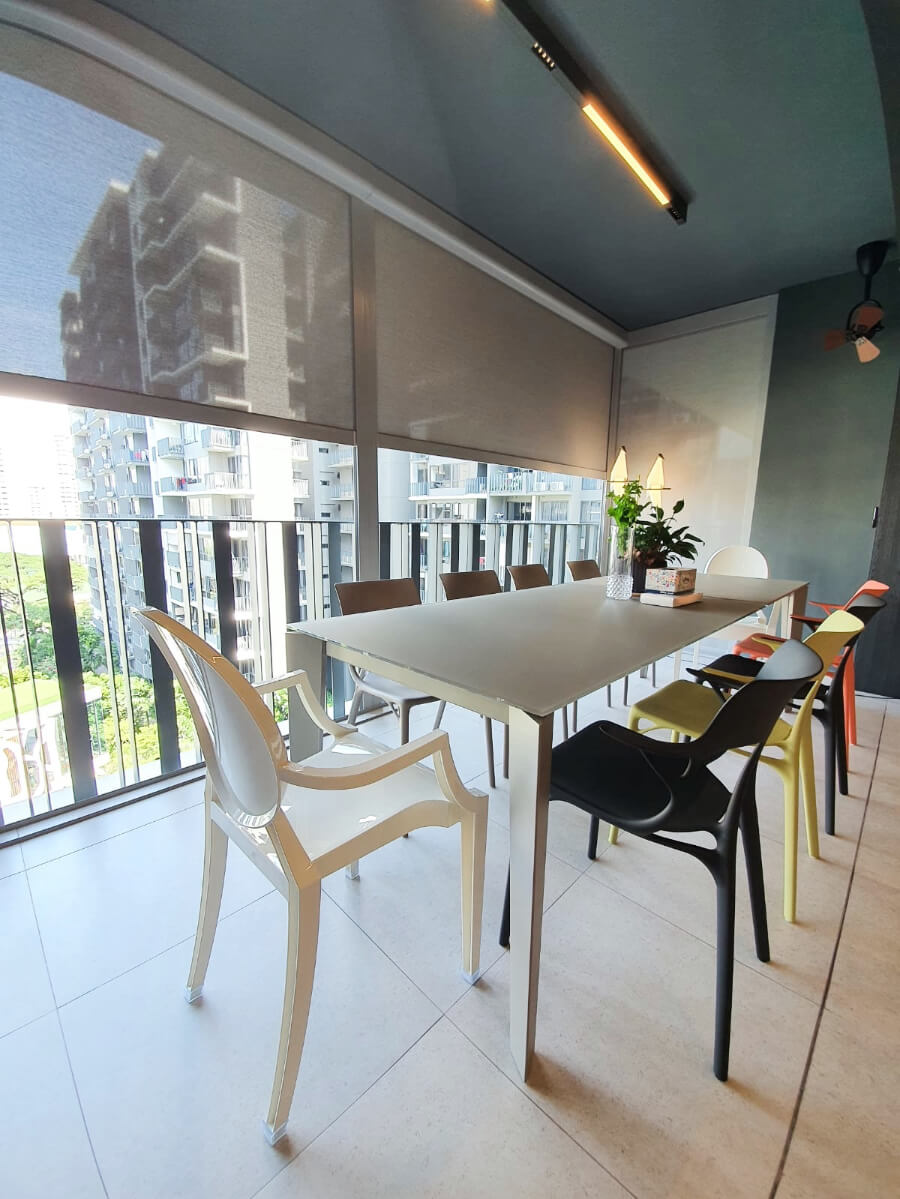
Outdoor roller blinds solve this — not just as a product, but as the infrastructure that makes everything else possible. A mesh blind with 3–5% openness cuts glare and UV while still allowing a cooling breeze. A weatherproof PVC blind keeps the afternoon squall out so your furniture stays dry. Your balcony goes from a space you admire to a space you live in.
Afternoon Sun
UV-rated mesh fabric diffuses harsh glare into soft, even light — comfortable for people, kinder on plants and furniture.
Monsoon Rain
Weatherproof PVC or zip-track systems keep lateral rain out during heavy downpours — your outdoor furniture stays dry year-round.
Cooler Indoors
Blocking solar heat before it reaches your windows measurably reduces the load on your air-conditioning — and your electricity bill.
For most Singapore homes, a 3–5% openness mesh fabric works best — enough shade to be comfortable, enough transparency to preserve the sense of being outdoors. West-facing units with strong afternoon sun may prefer a denser 1–3% fabric. Full blackout PVC is best reserved for spaces you want to fully enclose, like a covered patio used as an extended living area.
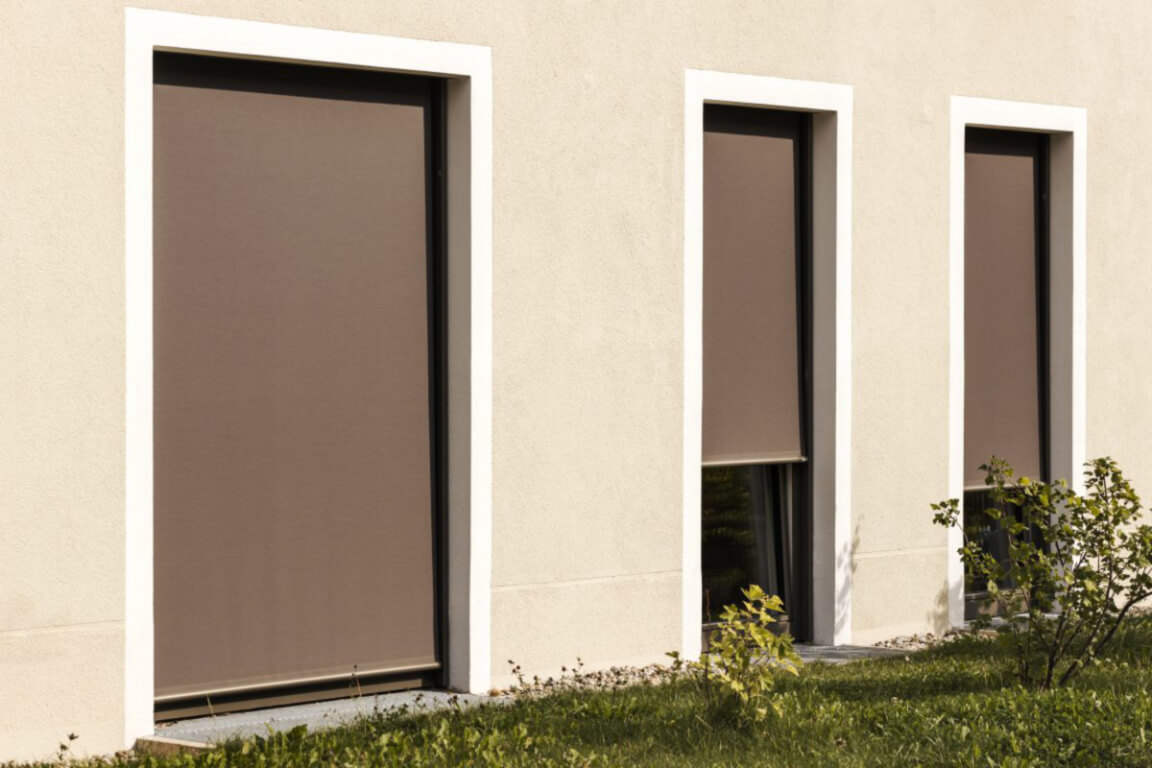
Protect against insects, sunlight, rain and lack of privacy — all while reducing energy costs by keeping your space naturally cooler.
4. Open Up Your View with Invisible Grille
Safety doesn't have to mean bars on your view
If you've ever stood on a beautifully designed balcony and looked at the view through a grid of metal bars, you know how much a traditional grille diminishes the experience. The view is there — you can tell — but the bars reduce it to something you look past rather than look at.
Invisible grille — tensioned stainless steel cables in a slim aluminium frame — gives you the same child safety and fall protection without the visual clutter. The cables are barely noticeable at normal viewing distances. Your park view, pool view, or city skyline is visible the way it was meant to be: unobstructed and beautiful.
| Feature | Traditional Metal Grille | Invisible Grille |
|---|---|---|
| View quality | ✗ Heavy bars obstruct sightlines | ✓ Near-unobstructed vista |
| Natural light | ✗ Partial blocking and shadows | ✓ Full, unfiltered natural light |
| Child & pet safety | ✓ Effective | ✓ Effective (SS316 stainless) |
| Aesthetic | Industrial; dates quickly | ✓ Clean, minimal, timeless |
| Opening options | Fixed or heavy sliding panels | ✓ Openable sliding variants available |
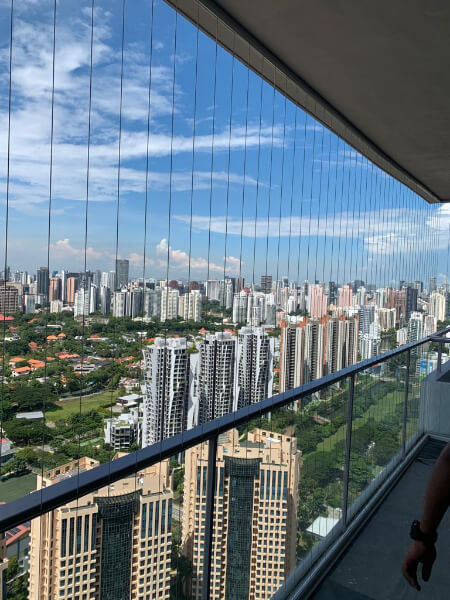
Fixed, openable sliding, casement and structured options. Affordable pricing, professionally installed.
5. Choose Furniture Built for Singapore's Climate
The wrong materials won't survive one monsoon season
This is where many homeowners waste money — buying indoor or temperate-climate furniture for an outdoor space in Singapore. Wooden chairs warp and crack. Metal rusts. Fabric cushions go mouldy within months. After a year, the balcony looks worse than it started.
The right materials handle what Singapore throws at them: UV radiation, persistent humidity, tropical rain, and heat. Invest once in the right things and they'll still look good in a decade.
Teak & Acacia
High oil content makes both naturally water-resistant. Teak weathers to a beautiful silver-grey without treatment; acacia is denser and more affordable.
Resin Wicker / PE Rattan
Synthetic rattan — woven from polyethylene — looks exactly like natural rattan but handles rain, UV, and humidity without cracking or fading.
Powder-Coated Aluminium
Lightweight, rust-proof, and available in beautiful matte finishes. Ideal for frames, tables, and accent pieces where you want a clean, minimal look.
Look specifically for Sunbrella or Olefin fabric cushions — both are engineered for outdoor use, with UV-stable dyes and quick-dry foam cores. Keep them stored or covered during extended periods of rain. Even good outdoor cushions benefit from being brought inside during thunderstorms.
For very small HDB balconies (under 5 sqm), the single best investment is often a foldable two-seater bistro set — one small table and two chairs that can be folded flat against the wall when not in use. This keeps the space feeling open rather than crammed, and makes it easy to use the balcony as a yoga or stretching space on the days you don't need the furniture out.
6. Create a Reading or Lounge Nook
A corner with a purpose becomes the corner you always go to
There's something particular about a well-designed outdoor reading nook. It's not just a chair on a balcony — it's a deliberate invitation to sit down and stay. The difference is usually layering: a comfortable chair with proper back support, a side table at the right height, something underfoot, something overhead that diffuses the light.
In Singapore, this corner only works consistently if it's shaded. A morning nook on an east-facing balcony can get away without a blind; anything else typically needs one. But once that piece is in place, the nook becomes genuinely usable for large parts of the day — and it tends to become the most-loved spot in the home.
- The chair: A deep-seat armchair or egg chair with outdoor-rated cushioning. Hammock chairs work beautifully on balconies with a strong ceiling or beam to anchor them.
- The side table: Low, stable, weather-resistant. A small concrete or powder-coated steel table is virtually indestructible.
- The light: For evening use, a solar-powered lantern or outdoor string lights (warm white, not cool blue) transforms the mood completely. Avoid anything that requires a power cable trailing through a door.
- The shade: An outdoor blind on the sunny side, or a simple sail shade if your balcony structure allows. The nook only becomes a habit when sitting there doesn't require squinting.
"The homes where the balcony gets used every day almost always have one thing in common: there's a specific reason to go out there. A nook, a chair you love, a view of something green."
— Casa Creativa Team7. Bring in Plants — Go More Generous Than You Think
Greenery is the fastest way to make a balcony feel alive
Singapore's climate is genuinely one of the best in the world for growing things. With year-round warmth and abundant rainfall, plants that would be considered exotic or high-maintenance elsewhere thrive here with minimal effort. The challenge isn't keeping them alive — it's choosing the right ones for your light conditions and giving them enough space to look lush rather than scraggly.
The key rule with balcony plants in Singapore: fewer, bigger pots beat many small ones. One large Monstera or Bird of Paradise in a statement pot has far more visual impact than twelve little 15cm pots lined up along a ledge. Think in terms of layers — something tall at the back, something medium in the middle, something trailing at the edges.
A word on pots: terracotta breathes and looks beautiful but dries out quickly in Singapore's heat. Glazed ceramic or fibreglass pots retain moisture longer and are lighter — important for balconies with weight limits. If you're not sure about your balcony's load-bearing capacity, fibre-reinforced plastic pots are the safest choice for large plants.
8. Use Your Vertical Space with Wall Planters & Trellises
Most balconies have more wall space than floor space
A 6 sqm HDB balcony has roughly the same amount of wall and ceiling space as it does floor space — often more, once you factor in height. Most homeowners use almost none of it. Moving plants off the floor and onto walls and trellises frees up the floor for furniture and rugs, and creates that layered, garden-room effect that makes a small space look much larger.
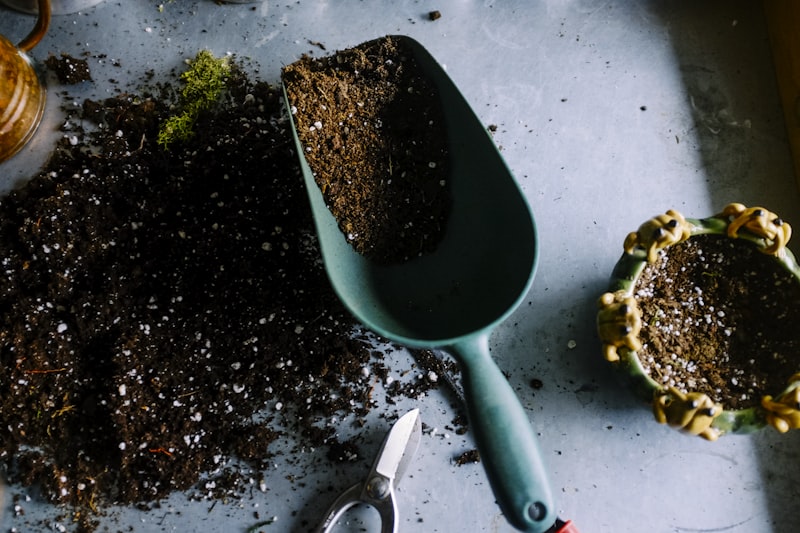
- Modular wall planters: Stackable pocket planters in felt or powder-coated metal fix to the wall with a few screws. Load them with trailing plants, succulents, or herbs. Look for systems that include drip trays — important for HDB floors and neighbours below.
- Trellis panels: A 60×120cm wooden or aluminium trellis fixed to the wall becomes a scaffold for climbing plants — star jasmine, betel leaf, and money plant all do this readily in Singapore. Within a year, a bare concrete wall can be entirely covered in green.
- Hanging planters: From the ceiling or from a wall-mounted rail, hanging planters add a layer of greenery at eye level that feels lush and intentional. Lightweight fibreglass or coir hanging baskets are best — heavy ceramic pots are a liability above head height.
- On blind installation and wall planters: If you're planning both wall planters and outdoor blinds, it's worth confirming the placement of each before drilling. A good installer will plan around your planting intentions, leaving the wall zones you want free for greenery.
9. Grow a Practical Herb or Kitchen Garden
The most-used outdoor space is one that earns its keep
A kitchen herb garden on the balcony does something that purely decorative planting doesn't: it gives you a daily reason to go outside. Pinching off Thai basil for a bowl of noodles, snipping chives for scrambled eggs, pulling mint for a drink — these small rituals build a relationship with the space that's hard to achieve any other way.
Singapore's climate is excellent for most culinary herbs, though they benefit from some afternoon shade — exactly what a mesh blind naturally provides.
Thai Basil
Fast-growing, productive, and far more flavourful than anything sold in supermarket packets. Prefers morning sun and consistent moisture.
Pandan
Quintessentially Singaporean. Grows vigorously in pots, needs minimal care, and the leaves are endlessly useful for cooking and fragrance.
Chilli
Bird's eye chilli thrives on a sunny Singapore balcony, growing into a compact bush that keeps producing. Visually appealing with bright red fruits.
Curry Leaf Tree
A small potted curry leaf tree is a kitchen game-changer. Grows steadily in a large container and can be harvested regularly once established.
For a functional kitchen garden, group herbs by water needs rather than species. Heavy drinkers — basil, mint, Vietnamese coriander — share one zone and get watered daily. Drought-tolerant ones — rosemary, chilli, thyme — share another and can go two to three days between watering. This prevents the most common mistake of overwatering some while underwatering others.
10. Incorporate a Small Water Feature
The sound of water changes a space completely
Nothing transforms the atmosphere of an outdoor space like moving water. A small tabletop fountain, a wall-mounted water feature, or even a simple glazed bowl with a submersible pump — the gentle sound of trickling water masks traffic noise, creates an immediate sense of calm, and makes a modest balcony feel like a private garden.
For Singapore balconies, compact self-contained fountain units are the most practical approach. They run off a small submersible pump, top up easily from a watering can, and can be solar-powered if you'd prefer not to run a cable. Choose materials that can handle outdoor conditions: cast stone, concrete, glazed ceramic, or stainless steel.
In Singapore, any still water becomes a breeding ground for mosquitoes within 2–3 days. A water feature must have moving water at all times — the pump should run continuously, or you should drain and refill the feature if it will sit stagnant for more than a couple of days. Adding a small aquatic plant like water lettuce or a single goldfish also naturally breaks the breeding cycle.
11. Go Motorised — For a Balcony That Responds to You
Small conveniences compound into daily habits
If you invest in outdoor blinds, the motorised upgrade is worth serious consideration — not because it's a flashy gadget, but because it removes just enough friction to change how often the blind actually gets used.
A manual blind gets adjusted once in the morning, maybe. A motorised blind gets adjusted whenever the light or weather changes, because adjusting it takes one button tap from the sofa. Over time, that means a balcony that genuinely adapts throughout the day — open in the cooler morning hours, shaded by 11am, closed against the afternoon rain, open again in the early evening — rather than one that stays in a fixed state because adjusting it requires stepping outside.
- Smart home integration: Most motorised systems pair with Google Home, Alexa, or Apple HomeKit. Set schedules, automate by sunrise/sunset, or link to a weather sensor that retracts the blind when wind picks up.
- DC vs AC motors: DC motors run noticeably quieter, last longer, and consume less power. If your balcony is near a bedroom, the difference in noise matters.
- Timer and scene control: Set a "morning" scene that opens the blind gradually over 30 minutes — a gentler way to wake up to natural light than a bright room switching on at once.
UV-resistant, weatherproof, custom-made to your dimensions. High-quality, practical options at affordable prices.
12. Add Personality with Accessories
The finishing layer is what makes a space feel yours
The infrastructure, the furniture, the plants — these form the bones of the space. Accessories are what make it feel personal. And unlike almost everything else on this list, accessories are low-cost, low-commitment, and easy to change as your taste evolves.
The key is restraint. Four or five well-chosen pieces create a curated feeling. Fifteen undifferentiated things create noise. Think about each item as something that should earn its place either visually (it's beautiful) or functionally (it's useful). Anything that is neither is just clutter with outdoor ambitions.
Outdoor Lanterns
Weatherproof LED lanterns in warm white or amber create evening atmosphere without wiring. Solar-charged versions are perfectly capable for soft ambient light.
Outdoor Cushions & Throws
The quickest way to update the look of a space. Change them seasonally, or swap them out when you want a different mood. Go for bold pattern or texture here — it's the easiest place to take a risk.
Ceramics & Objects
A single beautiful ceramic pot, a stone garden figure, or a wooden tray that holds your coffee ritual — small objects give the space a lived-in warmth that furniture alone can't provide.
Outdoor Mirrors
A weather-resistant mirror fixed to a wall doubles the perceived depth of a small balcony and bounces light into dim corners. Keep it away from direct western sun to avoid creating a heat spot.
Wind Chimes
One of the most overlooked balcony additions. Bamboo or aluminium wind chimes add both sound and movement — particularly calming on evenings when there's a light breeze.
A Small Outdoor Shelf
A narrow wall-mounted shelf gives the space a home for objects, plants, and a drink without eating floor space. A simple wooden floating shelf, well-oiled, lasts years outdoors in Singapore.
Where to Start
Twelve ideas is a lot to take in at once. If you're not sure where to begin, work through the list in order of impact-per-dollar. For most Singapore balconies, the sequence that makes the most sense is: commit to a colour palette first, then deal with the weather (blinds), then define the space (rug + furniture), then layer in the greenery, then add atmosphere and accessories over time.
The invisible grille and motorised blinds are bigger investments, but they're also the upgrades that tend to change how the space is used day to day — not just how it looks in photographs. Everything else can be built gradually. Those two, once installed, last a decade or more.
The balcony you're currently ignoring could reasonably become the room you use most. That's not hyperbole — it's a consistent pattern among homeowners who've made a deliberate plan for the space. The main difference between a balcony that gets used and one that collects dust is simply intention: the decision to treat it as a room rather than a leftover.